
Journal
The vocabulary of ballet: a short glossary for beginners
Ballet has its own language, and it sometimes puts beginners off. Yet these words are only landmarks. Here they are, explained, without jargon.
Why such a distinctive vocabulary?
Ballet has its own language, inherited from French: that is precisely why, from Moscow to New York, lessons are given with the same words. This vocabulary is not there to intimidate, but to name each movement precisely, to learn it and pass it on without ambiguity. A plié is a plié everywhere in the world: this common language lets a dancer follow a lesson in any country. Knowing a few of these landmarks before the first lesson does not make you more gifted, but it helps you feel at ease, and that already counts for a lot.
The basic movements, at the barre
The plié (bending the knees) opens almost every lesson: it wakes up the legs and sets the placement. The tendu stretches the leg and the foot along the floor, while the dégagé lifts the toe slightly off it. The rond de jambe traces a half-circle, on the floor or in the air. The frappé, for its part, works the sharpness of the foot. These movements, repeated in every lesson, build precision and turnout, that outward rotation of the legs, the signature of ballet, which comes from the hip and not the foot.
The role of the barre
The barre is not just a support for beginners: all dancers, even the greatest, begin their day with it. It is used to warm up, to find your placement and to settle the sensations before dancing without support. There you first work the demi-pointe (rising onto the ball of the foot), then, much later and only for some, pointe work itself. The barre is the workshop where everything later seen in the centre is patiently forged.
Positions and lines
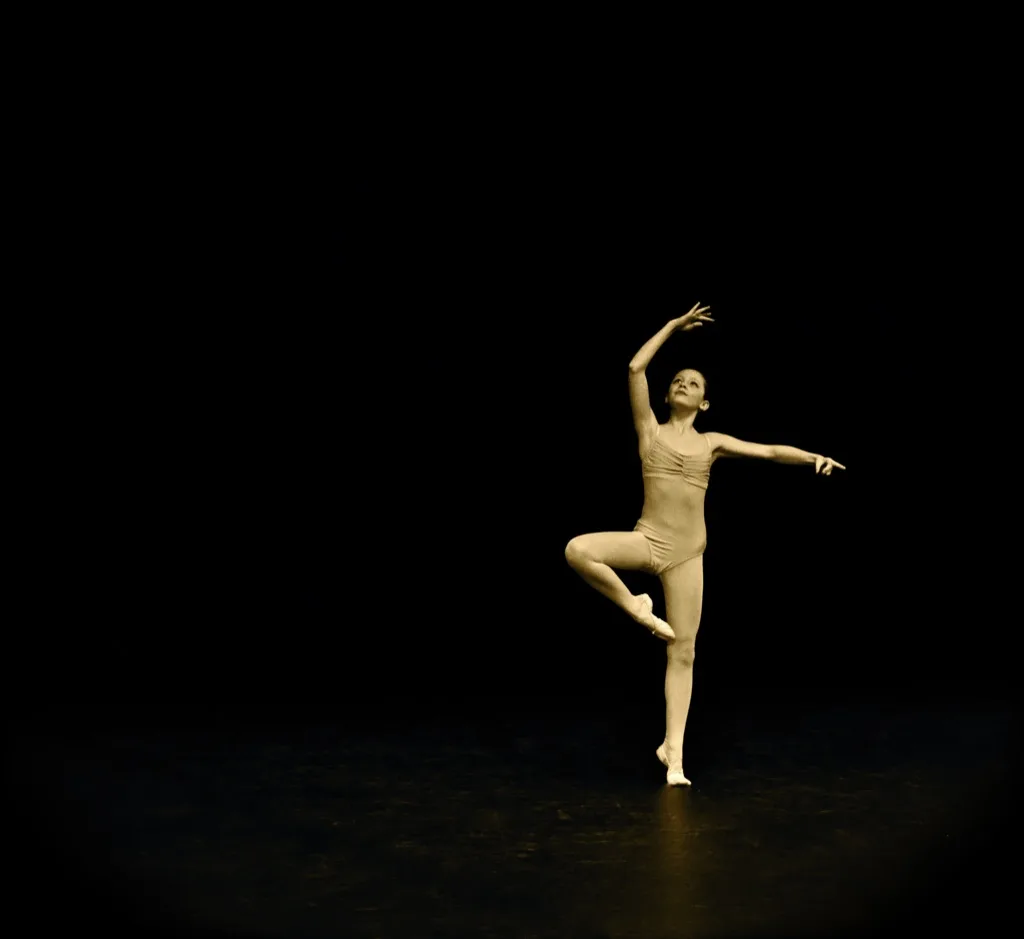
Everything starts from the five positions of the feet and arms, which organise the body in space and serve as the starting point for almost everything. There is also arabesque (one leg stretched behind, the body in balance) or attitude, very close but with the leg bent. The port de bras, for its part, refers to the way the arms move with grace and coherence. These lines are sought year after year: it is there, in their clarity and harmony, that the quality of a dancer can be read.
Jumps and turns
The sauté, the jeté and the assemblé belong to the family of jumps, each with its own way of leaving and returning to the floor; the pirouette, meanwhile, is the turn on oneself, where the gaze that "spots" a point helps you not to get dizzy. These words seem many at first, almost off-putting, but they come back again and again from one lesson to the next: very quickly, they stop being jargon and become a familiar language, the one you speak while dancing.
No need to worry: everything is learned in class
No one expects a beginner to know this vocabulary in advance. The teacher names, shows, corrects: the words settle in naturally, through practice, tied to a sensation and a movement. That is how you remember, not by reciting a list but by living each term in your body. Within a few weeks, plié, tendu and arabesque hold no more secrets, and you find yourself using, without a thought, words that once seemed so mysterious.
Discovering ballet in Nantes
The best way to get to grips with this language is still to step into a ballet class. At the Atelier du Mouvement, rue des Perrines, we welcome beginners from age 8 and adults of any age, in a teaching tradition inherited from the Russian school. For a glimpse of how a lesson unfolds, read "What is a ballet lesson like?". Fancy trying it? The first lesson is free, all year round.